Concrete flat roofs
Refurbishment, waterproofing and overlay of concrete flat roof decks. Common on 1930s–1970s flats, townhouses and post-war local authority buildings across the North East. Concrete is a brilliant structural deck — but it needs a properly bonded waterproof layer and decent drainage to actually keep the rain out.
The concrete flat roof in Newcastle
You'll find concrete flat roofs across the city — usually on three building types. Inter-war modernist houses (the Tudor Walters-era flat-roof experiments), 1950s and 1960s local authority flats (Byker Wall and similar), and a handful of 1970s town centre commercial buildings (parts of Eldon Square, the Bigg Market complex).
Concrete as a deck material is excellent — heavy, stable, fire-resistant, easy to insulate, and once it's in it doesn't rot, sag or move. The problem with concrete flat roofs is rarely the concrete itself; it's whatever waterproofing layer was originally laid on top of it. Mastic asphalt was the standard on pre-1980 concrete roofs and lasts 50+ years if it was laid properly — but a lot wasn't, and many have been patched or overlaid with felt that's now failing in turn.
Strip or overlay?
The single biggest decision on a concrete flat roof refurbishment is whether to strip back to the concrete deck or to overlay the existing covering. Both have a place:
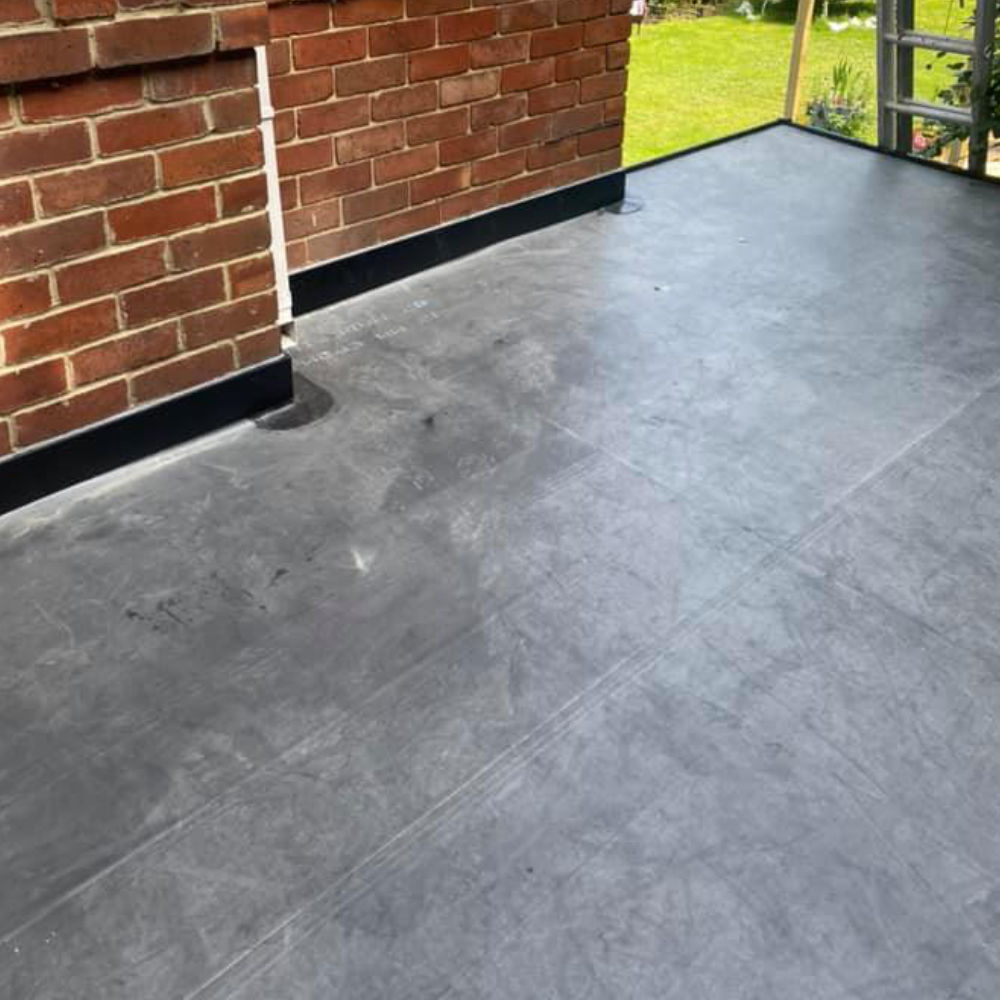
Overlay is usually preferable. Concrete decks are heavy, the existing waterproofing layer (asphalt or felt) is often bonded directly to the concrete, and stripping creates a lot of waste and dust. If the existing covering is largely sound and just past its service life, overlaying with a new membrane is faster, cheaper and just as durable. We typically use mechanically-fixed single-ply membrane or a liquid waterproofing system like Kemperol or Bauder Liquitec.
Strip-and-replace is needed when the existing covering has trapped moisture between layers (you'll see lifting, blistering, and persistent damp patches even when the surface seems intact), or when significant deck repairs are needed underneath. Stripping mastic asphalt off a concrete deck is heavy, slow work and can damage the concrete underneath — it's the option of last resort.
The systems we use on concrete
Liquid systems (Kemperol, Bauder Liquitec, Cromar Pro Liquid). Cold-applied multi-layer waterproofing reinforced with non-woven fleece. Bonds directly to almost any substrate including concrete, sound asphalt, sound felt and most metals. Particularly good for complex shapes, multiple upstands, awkward details that membrane sheets can't easily wrap around. Typical life 20–25 years.
Mechanically-fixed single-ply (Sika Sarnafil, IKO Armourplan). The right answer for large flat concrete roofs over 100m². New insulation goes down on top of the existing covering, then a separation layer, then the single-ply membrane mechanically fixed through to the concrete deck. Typical life 25–30 years.
Mastic asphalt overlay. The traditional answer and still occasionally the right one — particularly on listed buildings where the original covering was asphalt. Hot-applied, jointless, exceptionally durable. We don't do this in-house but we work with a specialist asphalter on the few jobs that justify it.
Drainage
One of the most common causes of failure on old concrete flat roofs is inadequate drainage. The original architects often relied on a single outlet for the whole roof, with very shallow falls. As the building has aged the falls have settled, the outlet has partially blocked, and water pools in the same spot — eventually finding its way through.
Part of any concrete flat roof refurbishment we'd quote includes assessing the drainage and adding additional outlets where needed. New parapet weirs, additional rainwater outlets, repositioning the existing outlet to the lowest point of the roof — small interventions that make a big difference to longevity.
Insulation upgrade
Most pre-1980 concrete flat roofs have no thermal insulation. The concrete deck itself has poor U-value. As part of any major refurbishment we'd add a layer of PIR insulation (Celotex, Kingspan or Recticel) to bring the roof up to current Building Regs (U-value 0.18 W/m²K, typically 120–150mm of PIR). This makes a noticeable difference to heating bills and to comfort in the room below.
Listed buildings and conservation
Many of the older concrete flat roofs in Newcastle are on listed buildings or in conservation areas. We've worked on a number — the constraint is usually around like-for-like replacement of the original waterproofing material (asphalt being the most common). We work with the local conservation officer at design stage and submit Listed Building Consent applications where required.
Other things we install & repair
Leak Diagnosis & Repair
Tracking the leak path properly, then patching it permanently.
Read more →Felt Roofing
Three-layer SBS torch-on felt for awkward shapes and tight detail.
Read more →Solar Panel Mounts
Ballasted tilt frames that don't pierce the membrane.
Read more →Skylights & Rooflights
Kerb-mounted Velux, Fakro and Keylite flat-glass rooflights.
Read more →GRP Fibreglass
Hand-laminated, walkable, takes paint or anti-slip aggregate.
Read more →Commercial Roofs
Single-ply for industrial units, schools and retail.
Read more →Get a free written quote — no charge, no obligation
Tell us about your flat roof. We'll arrange a site visit, give you a fixed-price written quote, and explain the options in plain English.